

Derivatives Market Structure Changes (Produced in association with Commodity Markets Council)
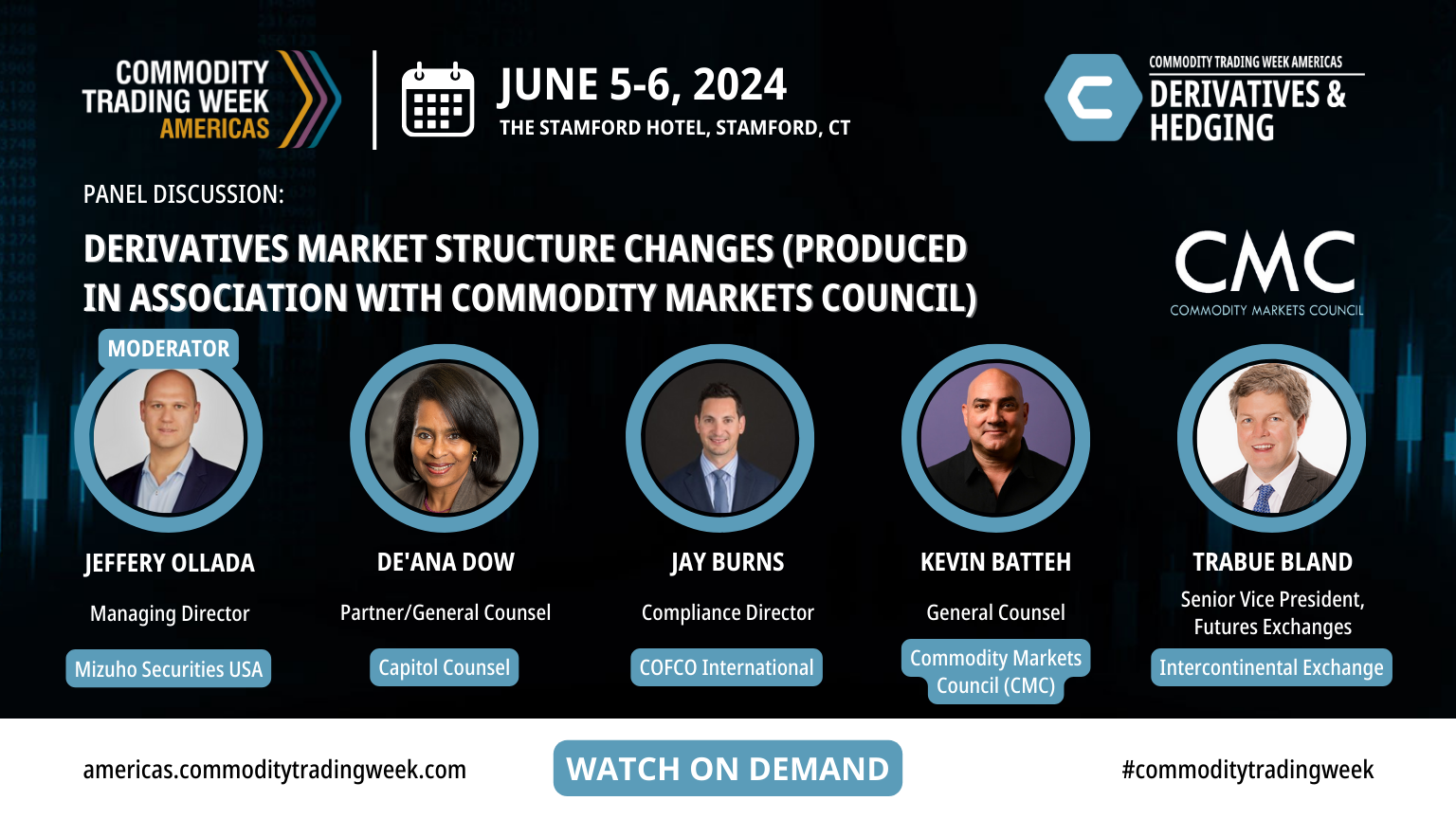
- Recent changes in derivatives market structure
- Impact of regulatory reforms
- Future trends and innovations
DeAna Dow, Managing Director, Capitol Counsel
Jay Burns, Senior Executive, COFCO International Limited
Kevin Batteh, Partner, Delta Strategy Group
Trabue Bland, President, Intercontinental Exchange
Jeffery Ollada, Managing Director, Mizuho Securities USA
Transcript
SPEAKER A
Sealed office building. And none of them have ever probably seen a farm or probably have zero idea of how things are powered to them. They probably think that the stuff that you get at Whole Foods is grown in the back of the store. And so they pass a bunch of rules that are meant to, they have a good intent. It's meant to get banks to hold more capital against the risk they have. Yet the way they design them seems to really impact the commodities industry and the clear commodities industry.
Now, remember going into Dodd Frank, the purpose of Dodd Frank, at least title seven, was to move more products into clearing. Commodities were already cleared for the large part, I mean, even voluntarily, in the energy markets. So there wasn't really much for them to solve there. But what they did, typical fashion, is they did the exact opposite. They made it actually harder to clear. So they assigned a risk weighting to commodities that was way out of line. They treated them, and you know this much better than I do, they treated it basically as two transactions instead of one transaction. The way that they ended up putting the, like the method they used to compute it was just penalized commodities trading, especially liquid commodities trading. And so they do this and the outcome is that less people can clear.
Clearing. Members started firing clients because they had to. Because the way that they're risk. And it wasn't, it was fairly random. I mean, these weren't unsafe firms. These were firms that just brought risk to that particular clearinghouse that happened to push their capital requirements up to make it uneconomic to clear for them. It also caused a ton of consolidation in the clearing industry. So at the end of it, clearing is more expensive, it's harder to get. And for the large part, if you're a new participant, there's a lot of barriers to entry. So a lot of times a firm doesn't want to talk to you. That's for commodities. Now, if you're clearing something that doesn't have that, there's actually, the bank will rush out to get your business. So if you're doing like an equity derivative, well, that's a little bit easier for them from a capital perspective.
All that made zero sense to me. I know it made zero sense to you. We went up and argued and sort of commodity markets council. So you would think, okay, well, the Fed really got that one wrong. What do they do now? And then they went out and did something called the Basel III in game, which gets even more idiotic. And if you're working at the Fed, I'm speaking for myself and not for ice. And so what they do with Basel III is they do a lot of weird stuff like you need to be a publicly traded company in order to access clearing. That doesn't make any sense. And they again increased the penalties on it almost to the effect that you're like, maybe these people who are writing these rules were fired by the CFTC or something like that and they just hate clearing. I don't know. I mean, the nice thing is, is that 90%, if you look at the comment letters, it's about 90% of the US economy commented against it. I mean, the only people that I saw that were in favor of Basel III endgame were academics and a few super pro regulatory nonprofits in DC who, you know, any amount of regulation short of summary execution is not enough. And so hopefully we're able to unwrap this. My hope going into Basel III Endgame was that we were going to unwrap some of the stuff from Basel III. That's just not the direction of travel right now. But I'm hoping at some time in the future people wake up and see the benefits of central cleared commodity derivatives.
SPEAKER B
Yeah, and I guess to put the clearing member perspective on some of the framework that you'd mentioned, you know, out of the gate, you know, over ten years ago, we were looking at a calculation methodology according to the current exposure method, which has this product lookup table at which commodities are the far end in the other bucket that says you have to take ten to 15% of the gross notional, which compares to where fixed income instruments are, which are taking zero to 1.5% of the gross notional. So, you know, clearly at a disadvantage. There has been some improvement to that. And I guess the other thing that I will say is that those calculations are grossed up without the benefit of netting, which means if you are an integrated oil company that has both upstream and downstream products in the same portfolio, we're taking the gross exposure for both sides of that trade, even though they're a natural hedge to themselves and are risk offsetting. Now, that part has been solved to a certain extent under the SACR methodology, there's been hedging sets that have been created. So crude oil and products are in a hedging set together so that upstream downstream system problem has been resolved. Say you're a generator that burns gas to create electricity. Those are in two distinct hedging sets, so all belong. The fact that if there is a default at any client at an FCM, we have the ability to offset or to close out positions without respect to the underlying product. Completely understand that over time correlations may deteriorate, but the realities of the legal agreements, such as they exist, allow us to liquidate without restriction amongst netting sets. So yeah, I completely agree with you. There are some serious challenges. And I think the punchline for commodity end users has really been high exposures and leaving the banks in a position of having to cover those capital costs.
SPEAKER A
And harder to clear. I mean, I'm assuming you fired some customers.
SPEAKER B
And we have had to have some difficult conversations over the many years. I mean, very difficult conversations. And they're difficult because they're not tethered to an economic reality. So it's not, you know, we come and see one of the first exits that we had to make was for a client trading crude options, because at the time, the current exposure method was not taking the delta on that option, it was making you gross up at the strike price. So you got an option strategy on and those were by far the worst exposures, commodity options clients. So yeah, very difficult conversations because difficult conversations that are rooted in reality are easy to have, right? You have data and all this here, you just say the numbers are in the rig.
SPEAKER C
When we first started working on this issue together as part of the Commodity Markets Council in 2014 and the first Basel proposal, we tried to explain to the Fed and other prudential regulators the real-world impact of getting capital wrong with respect to derivatives and explain the risk-reducing benefits of derivatives, and how marking these as sort of like a 100% exposure didn't make sense. We took in, and I won't use the firm names, but a large agriculture merchant and all the exchanges were there and we said, okay, here's a letter from a large ag merchant to a grain co-op. And it says, hey, we're going to give you a fixed price. We're going to buy all your grain for politics tributary, I don't know if you guys have a grain contract with canola, one canola. I won't use CME as the example, even though it was CME. We're going to buy your canola at ICE price plus x on the date that we fixed, and that guaranteed the farmer the ability to lock in the price of their crop. And then that ag merchant would then go in turn to ICE or whatever exchange and use a futures contract to hedge that out. So they essentially have a zero-zero risk in offering that merchandising service to the AG customer, to the farmer or the co-op. And that ag merchant was a large ag merchant. It is a large ag merchant. They're still in business got a letter from their FCM bank that said, and I think all the customers probably did, that said, based on regulatory changes, we may not be able to do your business or we're going to have to increase the charge that we levy on you to do this clearing business, to do this cleared derivatives, this cleared futures business. And at the end of the day, either they don't get access to clearing and they just stop offering that service to the co-op or they continue to get it at a higher price and that higher price gets passed down to the farmer and that ultimately gets passed down to the end user, to the person who's got to buy bread or canola in the oil in the grocery store. So we've throughout this process tried to ground this sort of a reality that tribut probably put it more dramatically than I did.
SPEAKER A
But you know me, drama.
SPEAKER C
Yeah. Show that this doesn't come from the back of Whole Foods, it comes from this supply, this value chain. And you're making merchandising commodities much more expensive. And that's not going to punish the merchandisers, it's going to punish the average consumer. And so that's sort of how we've tried to frame this issue when we're advocating and you know, like I said, started in 20, I don't know, 1415. And it's been unfortunately been going on.
SPEAKER B
Ever since we got the email in 2012. So we've been suffering for twelve long years.
SPEAKER D
Yeah. Just so, just to add a little emphasis from the buy-side perspective is it does go all the way down to the producer level, the farmer level. I mean, anything that impacts the ability for farmers to properly manage their risk is going to impact the merchants. It's going to impact our relationships with our clearing partners. We have to review all that, or commodity merchants have to review all that.
And then if you're not very familiar with how farmers actually hedge, it's primarily through introducing brokers. That's a dying business to begin with. These types of rules are just going to kill that business. It's going to make it harder for them to manage their risk. They're going to go elsewhere. An absent new FCM capacity, I think might get into that a little later. Those clients that the banks and the brokers are having these difficult decisions with aren't just stopping clearing, they're just going elsewhere. So you're pushing all that down and then you're eliminating the ability for these bottom-line producers to be able to manage their risk.
SPEAKER B
Yeah, I mean, I would say the other unfortunate aspect of to the extent that these are gross notional based frameworks in the 2022, commodity energy market volatility and grain market volatility, I'm sure you similarly had an interesting experience in 2022 navigating through the grain markets at that time. But heading into the first, the spring of 2022, our firm had about $6 billion in customer funds. Midway through 2022, with the uptick in volatility, we had grown to $18 billion in customer funds. Now, part of that was due to the margin rate increases by exchanges, but it was also several of our existing clients coming to us and saying, we need to put additional positions with you because I'm being communicated a gross notional limit at my existing broker. So in that crisis scenario, those clients had the extra capacity at our firm, but we're even at that $18 billion in an industry that has over 400 billion in customer funds across all asset classes. I think you can understand the stress in the stress scenario and the potential for pro-cyclical impacts, particularly from a liquidity perspective. So I think maybe we've beaten the. I think we may return to it in a bit, but maybe the final point that I put on that is that one of the observations that we had is that there were some direct clearing members that your exchange took on, and maybe we'll kind of turn to the DCO topic and ask Deanna to talk about the CFTC's customer funds rules that have recently been proposed and maybe talk about what's driving that proposal.
SPEAKER E
Yeah, we haven't seen over time a lot of changes in market structure within our industry, but more recently we are seeing those types of changes. And so the direct clearing piece, which Jeff just mentioned, is something that is relatively new and that the commission didn't feel like there were adequate protections around customer funds that were coming in directly without the benefit of being an FCM customer. So as a result, the commission has recently approved several DCOs that provide direct clearing models without intermediation. And so the proposal is intended to provide similar protections for proprietary funds that the DCOs have already in place for your traditional FCM customer funds. The proposal addresses things like, we all are familiar and comfortable with the treatment of funds in the event of a DCO bankruptcy segregation, commingling, written depository acknowledgments, naming of customer fund limits on the use of clearing member proprietary funds and investments of DCOs can make with such funds, and on and on. So things that have already been in place for your traditional FCM customers would now be permitted or put in place to provide protections for those customers that are coming in directly to the clearinghouse. And like I said, these are all very familiar to us. But here's one of the issues. The fact that they are applying this rule across the board to your direct clearing houses, DCOs, as well as to the traditional ones where everything is fine there, why are you fixing it and it's not broken? So by applying it, you're getting some duplicative types of regulations. And of course whenever you apply new requirements needed unneeded, there are additional costs. And those costs of course are passed down to, you know, the customers, to the commodities customers. So you know, that's one of the concerns. And then also when you look at the direct clearing model, you have to think about, you know, are the protections really comparable? Because when you're looking at the FCM, there are a number of protections that are provided through the FCM that you don't have get if you come in directly, including for example, shielding customers from default of other clearing members, assessing suitability of the product cleared and the level of risk and position concentration taken by a customer, know your customer, any money laundering checks at onboarding and ongoing disclosure documentation guaranteeing clients to central counterparties. So there are a number of protections out there that you get new coming in through the FCM that are not going to be provided because the new rule particularly deals with just the protection of the clearing member funds in the account. So that leaves the question open as to whether the protections are comparable to the protections that come through intermediated trading and whether the intermediate indirect clearing model should be subject to the same rules. Square peg, round hole. I mean, whether or not these are actually comparable types of activities and should be treated the same under similar rules. So I think there will be a lot of questions, you know, and hopefully consideration given when these rules ultimately are finalized.
SPEAKER B
And Jay, does that shape your appetite for me, a direct clearing member and.
SPEAKER D
No, not at all. From a commodity merchant perspective, no. However, I was at RJ O'Brien in 2011, so I had a front row seat to the MF global bankruptcy situation. So I saw how effectively and efficiently the FCM intermediary model worked over a weekend. So it's very hard for me to get behind and support rules that would eliminate all these additional customer protections that were created in the last 14 years and enhanced to roll those back. For me, it's a hard one to get behind because I've witnessed how good the FCM intermediary model worked. I mean, so really that's driving my opinion just from a compliance perspective, you never want to see those customer protections rolled back. And then having a conservative risk management bias, it just, to me, it doesn't sit well in my head.
SPEAKER B
And from the DCO perspective, are you trying to disintermediate all of us?
SPEAKER A
Look, I always want to try to put other people out of business, but no, we actually think and believe in an intermediated model. A lot of this came from crypto. It actually kind of wraps back into our first question, is access to clearing. So a lot of DCOs, when they're starting up now, and they want to clear things that I'm not going to do. They want to do healthcare products, and they want to do sports and event contracts and things like that. And FCMs don't want to touch those right now because they're capital constrained. And having to go sign up at another clearinghouse is just yet another thing that they have to go and put the guarantee fund up again, put resources behind that. So I understand where they're coming from, but these things basically operate in a lot of cases, like brokers, DCOs, and trading platforms, and sometimes they have a trading entity, too. That's what FTX was. That's a huge mistake. That is a hairball of conflicts and ways for things to go wrong. I mean, it's, to me, that doesn't make any sense. And it's like letting Homer Simpson run the nuclear plant type of.
SPEAKER B
I think I would just make one comment, because I completely agree with you that this is born of the crypto space. And really for that segment, out of necessity, because it was almost like the original was the self-certification of the bitcoin contract.
SPEAKER A
That was my competitor, and it sucked.
SPEAKER B
And from there, it was all just kind of downhill. Thou shalt not clear was seemingly the prevailing edict at clearing members across the street. So it's hard to fault them for heading in this direction, to say, okay, I need to find a new way to generate capacity for these clearing products if I'm going to have an open access market that's available to a broad array of market participants, because the FCMs are saying no. And bear in mind, we are one of those FCMs that we don't do the thou shalt not clear kind of thing, but it's just not our space. So they needed to create that capacity. So very targeted.
SPEAKER E
Yeah. And let me just add, and I'm not taking a position one way or the other. I actually represent an events market. And so beyond the bitcoin cryptocurrency space, the events markets because they cater to the retail market. So these retail traders are coming in directly to trade on these markets. And even so, these markets are recognizing the benefits of FCMs and are looking at putting an FCM option on the table for their markets as well.
SPEAKER D
So prior to me joining Coffco, I was the chief compliance officer at TD, Ameritrade, futures and forex, which is now Charles Schwab. And retail clients are the ones who need these protections and disclosures the most. So removing those and their perceived benefits are not exactly what they're going to end up being.
SPEAKER C
I think that's just, it kind of goes hand in glove. This whole conversation is the growing role of retail in the futures markets, because we're seeing it in certainly the event contract space, in the crypto space, but also in the traditional futures space, some exchanges are making smaller size contracts to make them more retail friendly. And I think there's a lot of risk if you don't have sort of a gateway or in the form of an FCM to sort of want to educate and to provide that customer protection.
SPEAKER B
So maybe we'll stay with that issue of governance and conflicts of interest. And Deanna asked you to turn
to the commission's proposal in that regard.
SPEAKER E
So, yeah, the governance and conflicts rule, it's interesting because there's acceptable practices and there's guidance out there already, but what is happening is those provisions are now being codified and turned into CEF and DCM regulations. A lot of that is, in my view, kind of going overboard and becoming a lot more prescriptive. But in any event, the movement to codify goes kind of to the point of, you know, these are not mandatory. And apparently, you know, the commission is not all that comfortable with the current status of things being flexible and not mandatory. So we're seeing the movement to impose rules. And so the governance and conflicts provisions while they are in the works, I think there is concern that it doesn't go far enough. I think there's concern that they should have included these exchanges, what do you call it, the integrated markets, where you're bringing in the FCM, where you're bringing in these other entities, and it doesn't do that. So that's one of the things that they have. You know, there's been criticism about in terms of, you know, the DCO governance and conflicts rules.
SPEAKER B
So you touched on the prescriptive nature of this rule. I think the other one we discussed was similarly prescriptive. Are there any tea leaves that you would read into that, as I think as a general manager matter in the approach of the commission?
SPEAKER E
Yeah, I certainly see a shift. When you look at a lot of the recent rulemakings, the protection of customer funds, the conflicts and governance and the events proposal as well. There appears to be specific, detailed requirements instead of flexible principles. And so I think you see the commission codifying these acceptable practices, the guidance. And I have a particular interest in this because I was actually at the commission when the CFMATi Futures Modernization act was implemented, and that is where the core principles actually came into being. I was actually counseled to Chairman Bill Raynor and we wrote that. And so the flexible core principles were, you know, something that the markets really thrived on. You saw considerable astronomical growth in the industry because now the exchanges were able to compete with the global markets. They were able to compete with the over the counter markets, which at that time were not regulated. And so there was a reason behind moving to the flexible core principles. And as a matter of fact, they have actually worked well. And I think it's particularly telling the governance and conflicts rulemaking released, there's a statement where the commission says acceptable practices provide examples of how DCMs may satisfy particular requirements of the core principles. They do not, however, establish mandatory means of compliance. Well, yes, that was the whole premise of a core principles regime, right, to provide flexibility on how DCMs can comply with the requirements. It works. And when you get into a situation of more prescriptive rules, you know, what it does is make things cost more. There are higher costs, there's less market driven innovation, there's slower growth, among other things. So it's completely inconsistent with the current statutory mandate because Dodd Frank certainly did not eliminate the core principles regime. And I just personally think it's going in the wrong direction. Like I said, obviously I have a vested interest because I practically wrote those.
SPEAKER A
Yeah. Oh, you want to go?
SPEAKER C
Well, I'll say all of those, plus also more enforcement if you have rules. It's more of a gotcha regime. And we'll have a good panel next on enforcement with Michael Brooks back there and his team.
SPEAKER A
So the way I look at it is like there's a finite number of law and order episodes out there. And if you add it up, it's probably about 3000 hours worth. And the commission's been at home for three years. So you probably worked your way through the entire law, which is what I think they showed them today. Right. And now they've gotten bored and now they're just writing up rules for things that were already done so they can maybe sue us later and get more money so they can stay at home. I don't know. It just doesn't make any sense to me. I haven't seen any reason for these rules, and, you know, except for they ran out of law and order episodes.
SPEAKER C
You know, little known fact, tribute, bland. Actually, at one time, and with me, we were both enforcement lawyers at the CFTC, but that was probably 20 years ago.
SPEAKER A
I thought you were gonna make a law and order reference.
SPEAKER D
No?
SPEAKER E
Yeah, I do remember when we were drafting the core principles, the staff of the commission was very unhappy. They did not like the direction of that rulemaking at all, because they felt like it was putting them out of a job, that they wouldn't have any work if, in fact, they did not have specific prescriptive regulations for them to administer. So they do seem to be slipping back in to that mode.
SPEAKER A
Yeah. And it's too bad. I mean, because I am 100% not the same exchange as CME. I'm not the same exchange as nodal or, you know, or calci. Very, very different models, different approaches to stuff, and that's all good. I mean, it's fine. You can choose how you're going to do this type of stuff, but I think we all do a pretty good job at it. And following those core principles, I don't see any reason for them to rip a rule, except that they want to stay at home and watch the law and order.
SPEAKER B
Why don't we turn to market volatility? And, Jay, I've referenced probably too much in my time up here, but why don't we turn to 2022 and talk a little bit about the challenges market at that time and the ongoing impacts from that period carrying into 2024.
SPEAKER D
Yeah, so, I mean, this has been discussed or referenced a few different times on a few different panels at a real high level. And it's no surprise. The Ukraine conflict at the early first quarter of 2022 was a huge challenge for just about everybody and at least the commodity merchants, commodity market participants, business operational challenges, logistical challenges, from the compliance side of things, sanctions. Sanctions were a huge deal. We're now on the 13th sanctions package, so every time a new one comes out, we gotta rerun through our customer database and our counterparties to make sure that they're not on that sanction list. And, you know, typically they are not. So, I mean, that was a huge challenge that continues on to today. Our policies, our procedures have all been enhanced because of that, to comply with sanctions requirements and the sanctions regimes. So, outside of Ukraine, later on in 2022, early 2023 drought in Argentina, that's from more of a commercial side. I don't really have much commentary on that. I'm sure our commercial teams do, but I don't. And then now we've been experiencing conflict in the Middle East. Always a concern. Any geopolitical events are a concern on how they're going to impact trade flows, logistics, freight, I mean, freight costs, you know, energy prices, things like that. We only deal, or international or Coffco Corp only deals in a handful of core agricultural products. So I don't have any experience in the cocoa volatility recently, but I. You know, there's a lot of concerns with sustainability and originating sustainable products and exporting them to different markets. In particular, the EU. There's a new EUDR rule, it's the EU deforestation rule, where you're not going to be allowed to import products that were. A certain class of products that are not, don't meet the sustainability requirements. So that's a huge challenge for all the merchants originating in Brazil, Argentina, the US. It's not as much of an issue because generally we're considered sustainable agriculture or non-deforested land. So that's just some of the things that have been going on in the last couple of years. But from a compliance perspective, sanctions, geopolitical events are always at the forefront of our thinking and guiding our strategy going forward.
SPEAKER B
Maybe we can take volatility and how it intersects with margin. You'll be pleased to know that in settings like this, I often cite the statistic that at one point in the journey of the TTF contract in 2022, it had 80% of the notional value covered by margin. And again, if I put on my risk manager hat, at a firm, there is no margin high enough. But if I put on my trader hat, I know that that has a measurable impact on market liquidity. So, as you're aware, I also had these consultations on initial margin transparency variation margin. So. And you all had that $7 billion vm in your quantitative disclosure. So maybe you can synthesize all of that.
SPEAKER A
Sure. Well, I mean, I'll start with TTF and why it got so volatile. I mean, TTF is the main energy pricing point for Europe. And. Oh, and the. All of a sudden, you shut off their main supply of natural gas. And actually, during the end of winter, beginning of spring, you have to heat stuff, you have to run German, everyone wants a BMW, and you got to have natural gas to be able to do that. The price went catastrophic. I mean, parabolic, because it just shot through the roof and no one knew exactly what was going to happen. What actually happened was that the Europeans did something extremely smart. They said, how long will it take to build natural
gas, basically, regasification terminals? And they came back with three years. There's no way that Europe would survive three years without any energy. So they said, what if we removed all of the government requirements around building a regasification plant? And the answer was 180 days? And they built those things in about 180 days. Shows you how fast that infrastructure can get built without all of the rules and regulations around that. But in the interim, our price went crazy. And it went crazy, too, because the German government basically announced that they were going to buy all the gas at once. Now, you guys can walk around the corner here to Sally's pizza and you can say, I want to buy all the pizza right now at once. And I can tell you that last slice of pizza is going to be insanely expensive and same thing with natural gas. So obviously, that level of volatility, because people were trying to find out what the market is without any supply. And same thing goes for cocoa, margins are definitely going to go up. Is 80% the right number? Well, that's what our models said. And our models were approved by the regulator. We were going back to the regulator during all of this saying, hey, we need to slow down on what the model is calling for and letting them know that this was taxing the energy community. We definitely don't want to do that, but there's not much we can do about extreme volatility like that. And the thing is for, given the geopolitical risk, given climate, weather-related events, these things are going to happen more. I mean, cocoa, if you tie it back to it. This virus was caused by unseasonable rain in Ivory Coast and Ghana, and that affects supply. And if you don't have enough supply, the price is going to go crazy. Same thing about winter storm Uri in Texas with ERCOT. When you have cold that's never been seen before in the state of Texas, that's going to, that's going to cause the price to rise and therefore margins, which we, you know, we margin on what the, you know, what the price action is, is going to go up.
SPEAKER B
So the era of the annual hundred-year storm, as it were, yeah, we'd.
SPEAKER A
Just be having it. We happen to have one every year. So. But on the positive side, look, and this goes back to our earlier comments, the markets have gone through this. We haven't seen any defaults. We haven't seen anything out there or any major defaults. It shows that these markets work and that maybe people shouldn't be throwing matches into the kindling.
SPEAKER B
There anything that you would add, Jay? Maybe some tea leaves into 2024 interview talks and some of the prevailing geopolitical climate.
SPEAKER D
Yeah. So aside from geopolitics in markets in particular sustainability, there's a lot of merchants, CPGs that have made these sustainability pledges. So now making good on those sustainability pledges is becoming more challenging. There's more interest in carbon derivatives trading markets obviously. Again, geopolitics kind of rules the day lately, I guess forever. So those are some of our challenges like meeting sustainability requirements, getting involved in new markets where we're going to be required to participate, where we might not otherwise participate like carbon credit markets and then just volatility, climate on weather in general.
SPEAKER B
I think that we are out of time. So please join me in thanking the panel and thank you all for being here.
SPEAKER A
Yes, thank you, panel.
Previous post
Technology leaders panel – Developing digital roadmaps for the next 12 months and beyond
Technology leaders panel: Developing digital roadmaps for the next 12 months and beyond. Focus on roadmaps, strategies, challenges, and opportunities.